- Nov 30, 2025
If You Haven’t Touched AI in Months, You’re Not Behind
- Tori AI
- AI Strategy & Operations
AI has been moving fast.
Life, clients, kids, deadlines – they move even faster.
Over the past months I’ve heard a similar sentence from many business owners:
“We tried some AI last year… then things got busy, we stopped using it, and now it feels like everyone else is way ahead.”
If that sounds familiar, take a breath for a second:
you’re not the only one, and you’re not behind.
I’m also in a kind of “reset” phase with AI in my own business, which is exactly why I wanted to write something small and gentle about how to come back to it — without drama and without guilt.
Why this doesn’t mean you missed the AI train
From the outside, it can look like the whole world is already running on AI.
In reality, even in big companies, a lot of what’s happening is:
a few small experiments,
some very enthusiastic people,
and a lot of very normal, non-automated work.
Real change in how a business works takes time.
That’s true for pricing, for processes, for hiring — and also for AI.
So if you:
opened ChatGPT or another tool a few times,
tried a couple of things,
and then got pulled back into everyday fires and deadlines —
that’s not a failure.
That’s… having an actual business.
The good news is that starting again now, with less FOMO and more clarity, can actually be better than trying to “keep up” with everything that happened over the last year.
You get to:
ignore a lot of noise,
choose what matters for you,
and build something small that fits your reality instead of someone else’s LinkedIn post.

Things you really don’t need to do
When people think “OK, this time we’re serious about AI”, the brain immediately jumps to big, heavy things.
Let’s put a few of those down, gently.
You don’t need 10 different AI tools
You don’t need to collect tools like Pokémon.
You can do a lot with:
one good chat-based AI tool, and
the AI features already built into tools you use now (Google Docs, Outlook/Gmail, Notion, your project tool, etc.).
It’s much more useful to really understand one tool than to touch ten tools and feel tired and confused.
You don’t need a 40-page “AI strategy” deck
You don’t have to write a big “AI Strategy” document to prove you’re taking this seriously.
Instead, a single, simple page is often enough. For example:
Where does it hurt most in the business right now?
Where do we have repetitive work we’re tired of doing?
Where are we missing information when we need to make decisions?
Three or four honest answers to those questions are already a direction.
No consultants, no buzzwords required.
You don’t need everyone to become prompt experts
Your team does not need a deep-dive prompt course to benefit from AI.
They mostly need:
a few concrete examples of how they can use it,
a sense that it’s OK to try,
and some clear lines for what AI is not for (final decisions, contracts, sensitive customer answers without a human eye, etc.).
That’s it.
The rest people learn step by step, in real life.
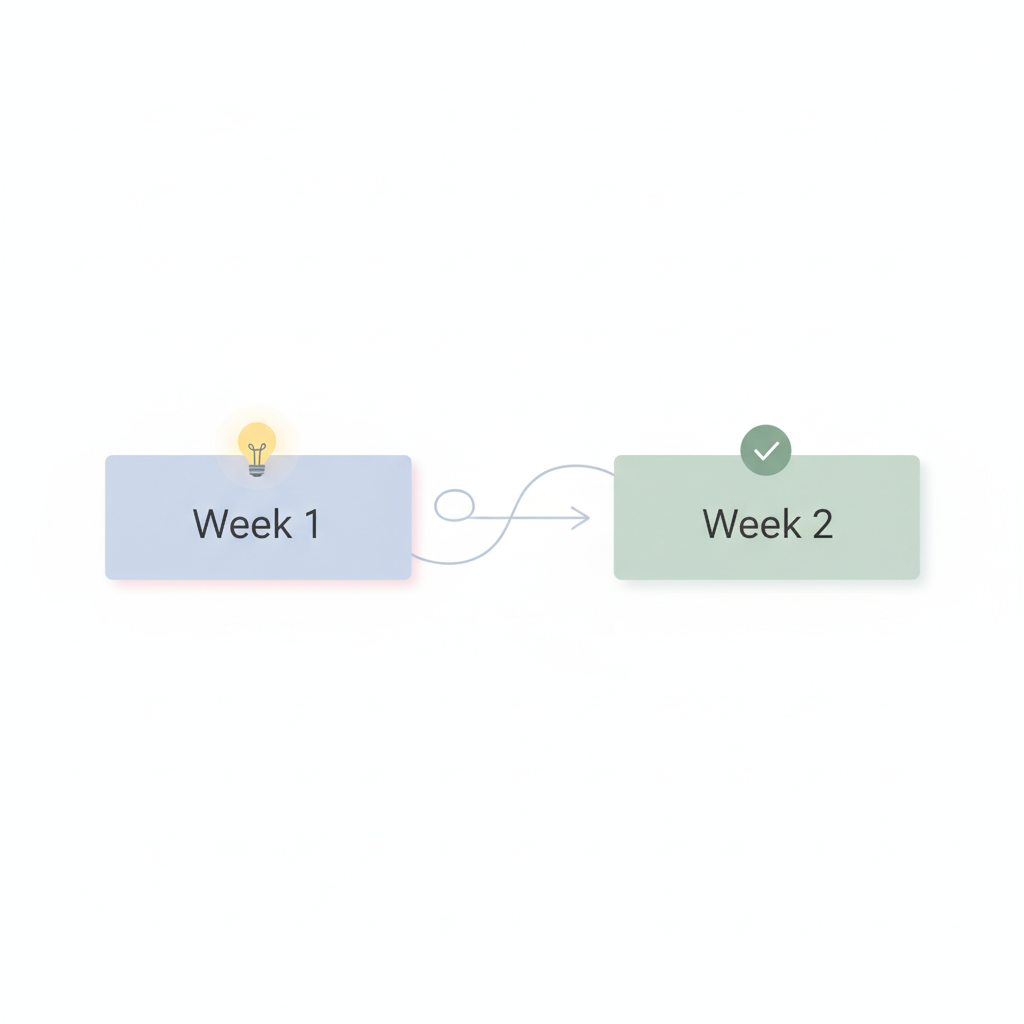
A gentle 2-week reset
If you’d like to come back to AI without pressure, here’s a small suggestion.
This is not a “transformation program”, just a quiet experiment.
Week 1 – Choose one thing
Pick one way to use AI. Just one.
Something like:
summarizing long emails or meetings,
drafting first versions of emails / posts / presentations,
turning messy bullet points into a tidy document or checklist.
The main criteria:
it repeats often,
it has some friction today,
and it’s not too critical or risky.
Every time this task shows up during the week —
you bring AI into the process. Not to take over, just to see where it actually helps.
No pressure to “do it right”.
You’re just collecting information.
Week 2 – Look back for a moment
At the start of the next week, block out half an hour.
Coffee encouraged ☕️
Ask yourself:
Where did this genuinely save time, even a little?
Where did it create confusion or extra work?
What did I wish it could do that it didn’t do well?
From there, you have three very simple choices:
Keep it – if it helped, decide “OK, this is how we do this task from now on,” and maybe write a tiny internal guide.
Adjust it – if it has potential but felt off, change something: a different task, a different prompt, clearer rules.
Drop it – if it just doesn’t feel right right now, let it go and pick a different use case next month.
There’s no “correct” answer here.
The goal is to get things moving again, not to impress anyone.

You’re allowed to keep this small and sane
There’s enough noise outside already.
You don’t need to add another layer of “I should have done more with AI by now”.
A small or mid-sized business doesn’t need glamorous AI stories.
It needs a few small, repeatable improvements that let people breathe a little easier.
If you’d like to do this reset with someone next to you — to look calmly at your business and ask “Where does it really make sense to start?” — that’s exactly where I come in.
No drama, no flashy slides.
Just figuring out, together, what would actually help you now — and then taking the next step.
Sign up for our newsletter!
Get the latest updates, AI tips, and insights
to help boost your business directly to your inbox.